The only free onlineattendance management systemwith location tracking app
or

The only free onlineattendance management systemwith location tracking app
or

Track your employee attendance with location tracking from anywhere and anytime using web and mobile app. Set reminders, alerts and notifications.

Work from home attendance and time tracker with live dashboard. Know who is available for work instantly using the live dashboard and instant notification.

Secure the attendance location with IP address lock and geo fencing. Tamperproof attendance data with non editable modes for employees.

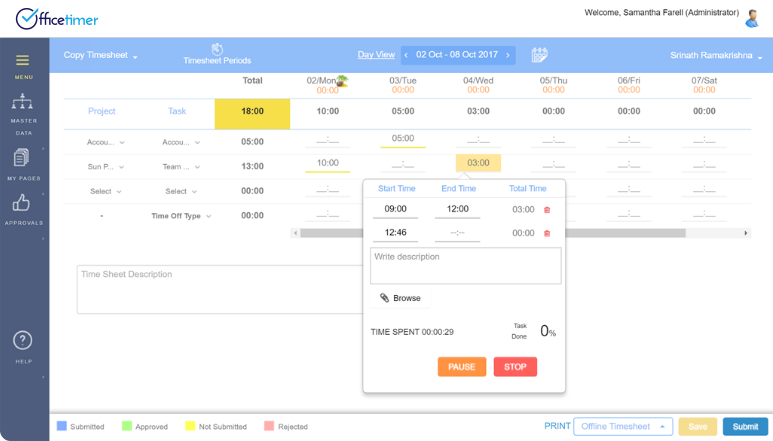
Integrate your timesheets with third party payroll, attendance and ERP software. Export to Excel, Pdf and other formats.




Unlimited usersUnlimited check-insUnlimited check-outsWeb attendanceMobile app attendanceUnlimited reports

But data has a fatal flaw: it numbs us. Psychologists call it "psychic numbing"—the inability to appropriately respond to the magnitude of suffering when presented statistically. We can intellectually understand that 1 in 4 women experience intimate partner violence, but that number rarely compels us to action.
Over the last ten years, the most effective awareness campaigns have undergone a radical shift. They have moved from "awareness as education" to "awareness as empathy." The engine driving this change is the raw, unfiltered narrative of the survivor. This article explores the symbiotic relationship between survivor stories and awareness campaigns, the ethical tightrope of sharing trauma, and why one voice in a dark room can change the world more effectively than a thousand statistics. To understand why survivor-led campaigns work, we must first look at the brain. Neuroeconomist Paul Zak’s research on oxytocin reveals that when a person watches a compelling, character-driven story, their brain produces oxytocin—the "bonding hormone." The more tension and emotional resonance in the narrative, the more oxytocin is released. Jabardasti Rape Sex Hd Video Hit
Rather than focusing on a single celebrity, Time aggregated the voices of hundreds of women across industries—from farmworkers to Hollywood actresses. The campaign did not just report on sexual harassment; it created a visual mosaic of suffering and resilience. But data has a fatal flaw: it numbs us
A statistic tells you what happened. A survivor story makes you feel as if it happened to you. Over the last ten years, the most effective
However, critics argue that this is a violation of the First Principle of this work: Nothing about us without us. A machine cannot consent. A machine does not heal. Using a fake survivor to solicit donations or sympathy feels dangerously close to fraud.
The likely path forward is a hybrid model: enhanced by technology (e.g., using VR to experience a survivor's memory) but never replaced by it. Conclusion: The Revolution of Radical Empathy We live in an era of noise. Every brand, every politician, and every algorithm is screaming for our attention. In this cacophony, data is white noise. It is easily ignored and quickly forgotten.


